
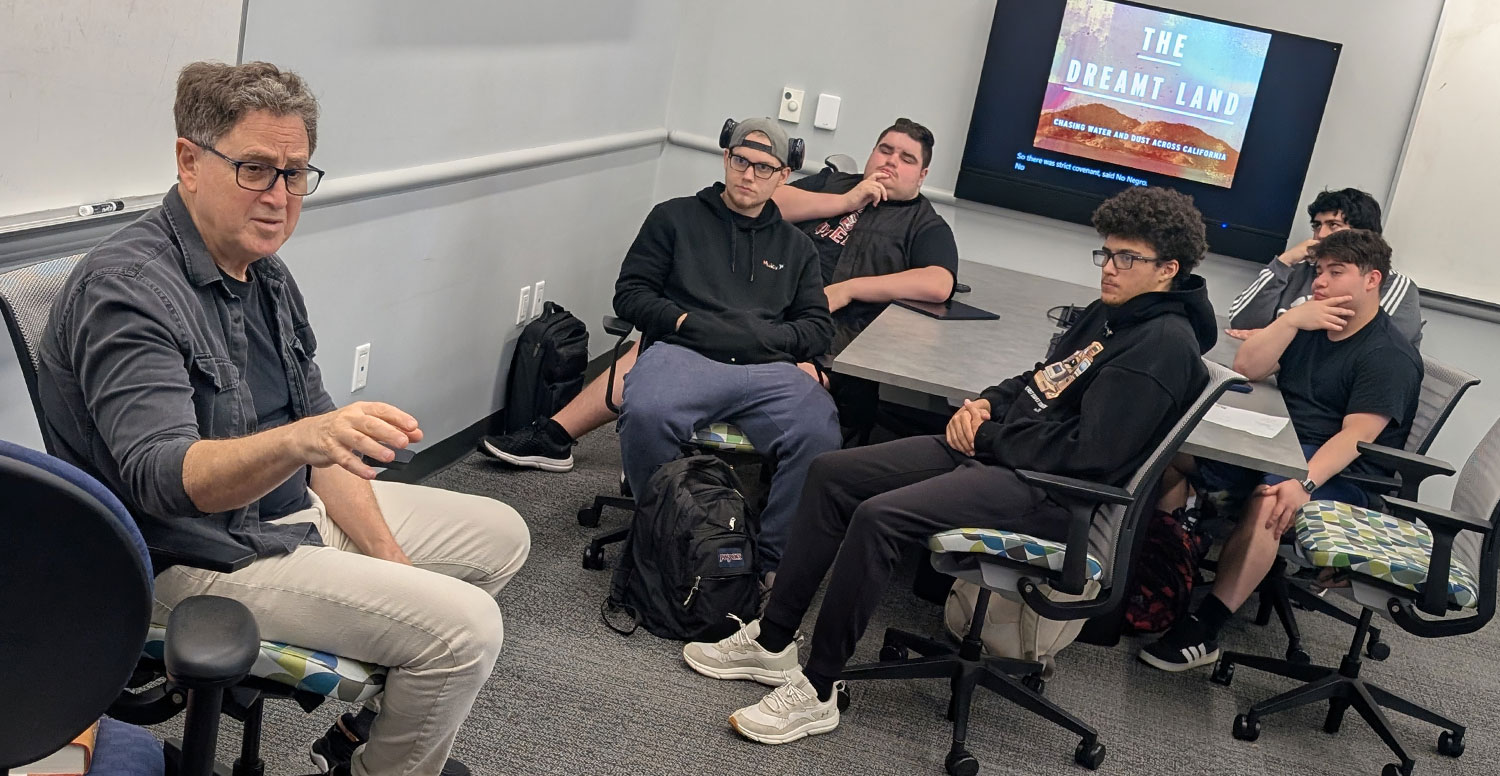
Spending an hour with one of California’s most accomplished storytellers left a mark on Rowan Alcocer.
“I was impressed by his ability to find a metaphor in almost anything,” the UC Merced student said. “He made his points in a way that was easy to understand.”
Alcocer, a first-year political science major, and other students in a California history class heard a talk by author and journalist Mark Arax, whose deeply reported stories reveal the people and paradoxes that stir the Central Valley he calls home.
Arax is wrapping up an academic year as the university’s writer in residence. In this role, he has given students up-close views of how he researches and writes, bringing the lessons to life with his gift for detailed, layered storytelling. Or, as was the case in Professor David Rouff’s class, Arax weaved history and his lived experience into an engaging talk about California’s unique tapestry.
His visit to the class was one of Arax’s last stops before a final lecture scheduled for Wednesday, April 22. Arax, author of landmark books about the Valley such as “The King of California” and “The Dreamt Land,” will speak in the Lakireddy Auditorium (Room 102 in Classroom and Office Building 1). The two-hour event will start at 3:30 p.m. and will be followed by a reception. There is no admission charge; an RSVP is requested.
The lecture will center on what Arax calls “the last extraction.” He explained that California is a contradiction — a world leader in social acceptance and environmental stewardship, as well as in military development and artificial intelligence.
Over the centuries, people in California have extracted Indigenous people from their land, slaughtered animals for fur coats, panned rivers and blasted mountains to oblivion for gold, and diverted Sierra water to thirsty coastal cities.
Gold, as a metaphor for discovery, riches and power, persists in California “like dust in the air,” Arax said.
He said the state’s last extraction is the human mind, prey to smartphones, social media and AI’s potential to turn our lives inside out.
“AI has already taken the whole of humanity and turned it into something that just makes money,” he said. “It’s here to exploit and extract from humanity.”
Arax said he found hope in the engaged, young students he met at his workshops and around the campus.
“It’s been a learning experience for me,” said Arax, who gave as good as he got. At one workshop, he talked about his 1997 Los Angeles Times article about the state champion McFarland High School boys’ cross country team (their story was developed into the movie “McFarland, USA”). At another, a former correctional officer joined him live online to flesh out a discussion of his Times exposé about guard brutality at Corcoran State Prison.
“The students have been deeply attentive to the story of Mark’s journey as a journalist and writer,” said Emily Lin, the UC Merced Library’s director of strategic initiatives, archives and special collections. The library and the School of Social Sciences, Humanities and Arts co-sponsored Arax’s residency. “They’ve seen how Mark continues to grapple with making sense of current events and issues that resonate with all of us.”
“I worry that technology has taken so much from them,” Arax said of his young listeners, “but I found there’s a lot of fight left in them, a lot of curiosity.
“I mean, they just blow you away with how bright they are.”
